
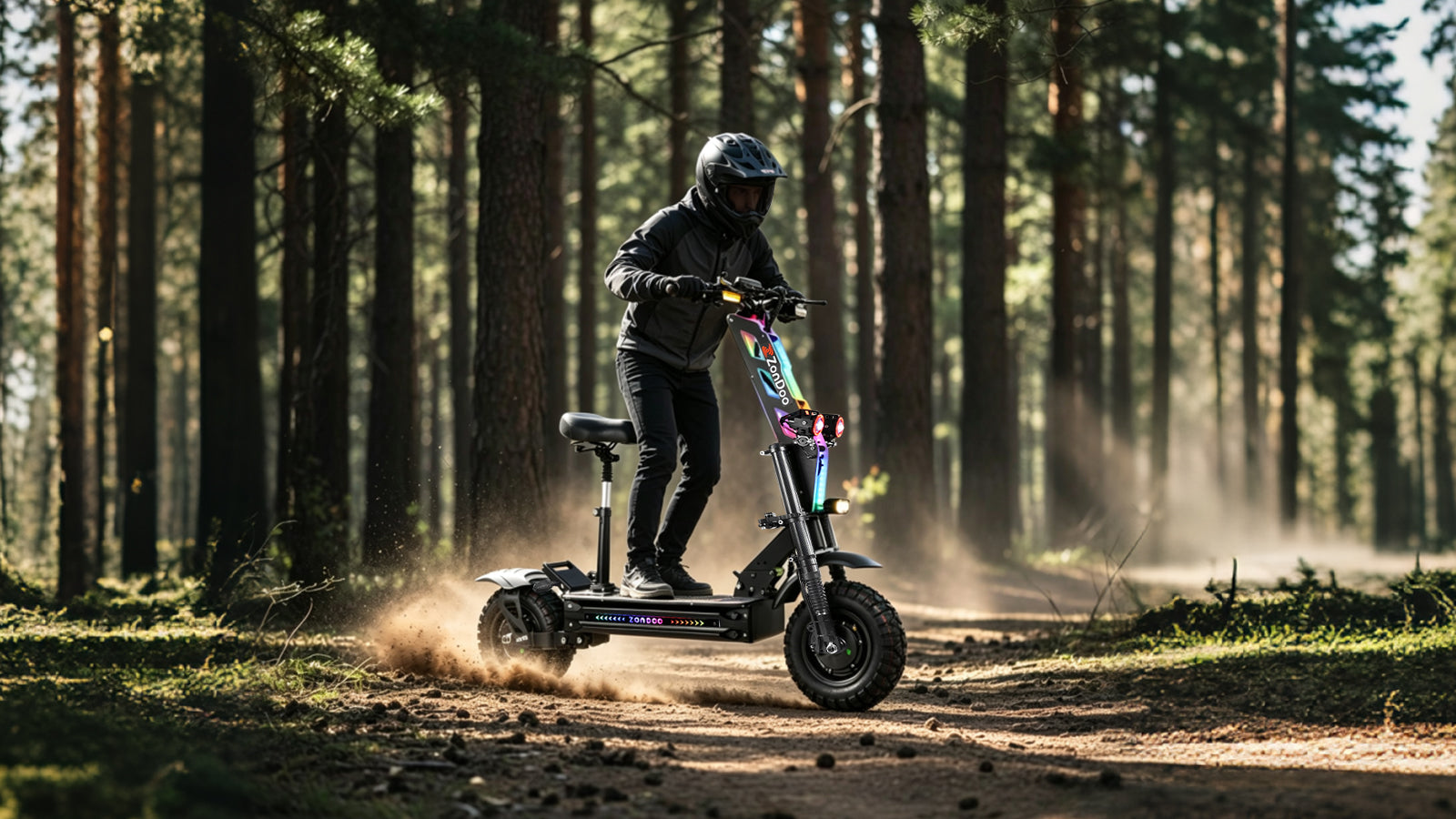
Choosing between a single-motor and dual-motor electric scooter is one of the most critical decisions for every rider. Your motor setup directly determines acceleration, hill-climbing power, off-road performance, battery range, portability, and even daily maintenance costs.
Many beginners mistakenly chase higher power blindly or settle for basic performance without knowing their actual needs. To help you pick the perfect scooter for your riding scenarios, we break down the full pros, cons, and real differences between single-motor and dual-motor electric scooters in this guide.
1. What’s the Core Difference?
A single-motor scooter relies on one drive motor (usually rear-wheel drive) to provide all power, designed for daily urban commuting and flat-road cruising.
A dual-motor scooter is equipped with independent motors on both front and rear wheels. It delivers doubled peak power, distributed torque, and all-wheel traction, built for high-speed cruising, steep hills, and rough off-road terrain.
2. Single-Motor Electric Scooter: Pros & Cons
✅ Advantages
-
Longer battery range: With only one motor consuming power and lighter overall weight, single-motor scooters feature higher energy efficiency. They deliver a far more stable real-world range on a single charge, perfect for long daily commutes.
-
Lightweight & portable: The simpler motor structure reduces body weight significantly. Riders can easily fold, lift, or store the scooter in small spaces, ideal for taking on public transport or carrying upstairs.
-
Affordable price & low maintenance: Fewer core components mean lower manufacturing costs and fewer failure points. Daily maintenance, part replacement, and repair fees are much more cost-effective.
-
Smoother casual riding: The moderate power output avoids sudden speed surges, offering steady and controllable speed for new riders, greatly reducing the risk of accidental slipping.
❌ Disadvantages
-
Weak hill-climbing performance: Single motors struggle with steep inclines (over 15–20% gradient). The scooter will slow down obviously or even stall when climbing with a heavy rider or load.
-
Poor off-road & wet-road traction: With power concentrated on a single wheel, it is easy to slip on gravel, muddy, or wet pavement. The scooter lacks stability on uneven terrain.
-
Limited speed & acceleration: It can only meet daily low-speed cruising needs. The acceleration is slow, and the top speed is limited, failing to support aggressive riding or emergency road overtaking.
3. Dual-Motor Electric Scooter: Pros & Cons
✅ Advantages
-
Explosive acceleration & higher top speed: Dual independent motors output double torque, delivering instant power bursts. The zero-start acceleration is rapid, allowing easy merging into fast urban traffic and meeting high-speed riding demands.
-
Superior hill-climbing capability: It handles steep slopes of 25–35% effortlessly without speed drop, even with heavy riders or cargo. It is the best choice for hilly suburban or mountainous areas.
-
All-terrain adaptability: Front and rear wheel distributed power provides balanced traction. It grips firmly on rough dirt roads, gravel paths, wet pavements, and bumpy trails, effectively reducing skidding and improving overall riding safety.
-
Strong load-bearing performance: The dual-motor system bears pressure evenly, with far lower power attenuation under heavy loads compared to single-motor models.
❌ Disadvantages
-
Shorter battery range: Dual motors consume more power simultaneously. Under aggressive riding, the battery drains faster, resulting in a shorter real cruising range than single-motor scooters with the same battery capacity.
-
Heavier & less portable: The extra motor and controller increase the body weight greatly, making it hard to carry or store, and unsuitable for frequent moving.
-
Higher cost & maintenance difficulty: More complex circuit and power structures lead to higher purchase prices. Meanwhile, double motor components mean higher failure rates and more expensive repair and replacement costs.
-
Higher riding threshold: The strong power output is easy to cause sudden forward surges. New riders may lose control if they operate improperly, requiring a certain riding foundation.
4. Quick Comparison Table
|
Features
|
Single-Motor Scooter
|
Dual-Motor Scooter
|
|---|---|---|
|
Acceleration & Speed
|
Stable & mild
|
Fast & powerful
|
|
Hill Climbing
|
Suitable for flat/slight slopes
|
Perfect for steep slopes
|
|
Off-Road Performance
|
Weak, only for flat roads
|
Excellent for rough terrain
|
|
Battery Range
|
Longer & more efficient
|
Shorter under heavy use
|
|
Weight & Portability
|
Light & easy to carry
|
Heavy & bulky
|
|
Price & Maintenance
|
Low cost & easy repair
|
High cost & complex maintenance
|
5. Which One Should You Choose?
Choose a Single-Motor Scooter if:
-
You mainly ride on flat urban roads for daily commuting
-
You prioritize long battery range and portability
-
You are a beginner or pursue stable and safe casual riding
-
You have a limited budget and low daily maintenance needs
Choose a Dual-Motor Scooter if:
-
Your daily route includes steep hills, bumpy roads, or gravel trails
-
You love high-speed riding and want stronger acceleration performance
-
You need to carry heavy loads or are a heavy-weight rider
-
You pursue all-terrain adaptability and extreme riding experience
Final Verdict
There is no absolute “better” between single-motor and dual-motor electric scooters—only the more suitable one. Single-motor models are the most cost-effective choice for daily urban commuting, focusing on efficiency and portability. Dual-motor models are tailored for performance and off-road enthusiasts, breaking through terrain and speed limits.
Define your riding scenarios first, then pick the motor setup that matches your needs, instead of blindly pursuing higher power!
Have you tried both single and dual-motor scooters? Share your riding experience in the comments below!
#ElectricScooter #ScooterGuide #DualMotorScooter #SingleMotorScooter #OffRoadScooter #CommuterScooter
Share:
What is a Certified Pre-Owned (CPO) Scooter? Everything You Need to Know